What It Costs
We don't post a flat number for opener installation because the job changes with the house
A straight swap on existing rail and bracket hardware is a different job from replacing an opener on a house where the header or track has shifted over sixty years of settling, which is common in the 1940-2001 housing stock that makes up most of this area. Belt-drive versus chain-drive, battery backup for winter power outages, and whether the old unit's wiring is even salvageable all move the number.
What we can tell you without a fact in front of us
If your house is on the older end of that 1940-2001 range and still has the original opener, expect the bracket and rail to need some rework no matter which opener you choose, because mounting standards have changed since those houses were built. We'll give you the real number after we see the header, the door weight, and the existing wiring - not before.
We serve the greater Wilmington area, including Edgemoor, Bellefonte, Elsmere, Newport, Wilmington Manor, Greenville, New Castle, Claymont, Hockessin, Pike Creek, Brookside, North Star, Bear, Delaware City, St. Georges, and Glasgow, and pricing structure is the same across that whole footprint
Why This Fails Locally
Most of the housing stock here went up between 1940 and 1965, with a thick band of 1960s and 70s construction spread across the sixteen communities we cover. Openers from that era, and even a lot of the replacements installed in the decades since, were never matched to the loads a severe cold climate puts on a door system. Cold makes steel springs stiffer and grease thicker, so an opener that's already working at the edge of its rated lift capacity in summer gets asked to do more in January - and the motor, not the spring, is usually what gives out first.
Older houses in this region also tend to have shorter headers and tighter garage ceilings than what current opener brackets assume, a mismatch that shows up as stripped mounting screws or a rail that flexes under cold-stiffened door weight. We see this pattern across the whole service area, not just one neighborhood, because the housing ages and the winters are consistent from Edgemoor to Glasgow.
The failure isn't random. It's a predictable result of pairing decades-old door hardware with a climate that stresses motors and springs hard for several months a year.
What Is on the Truck
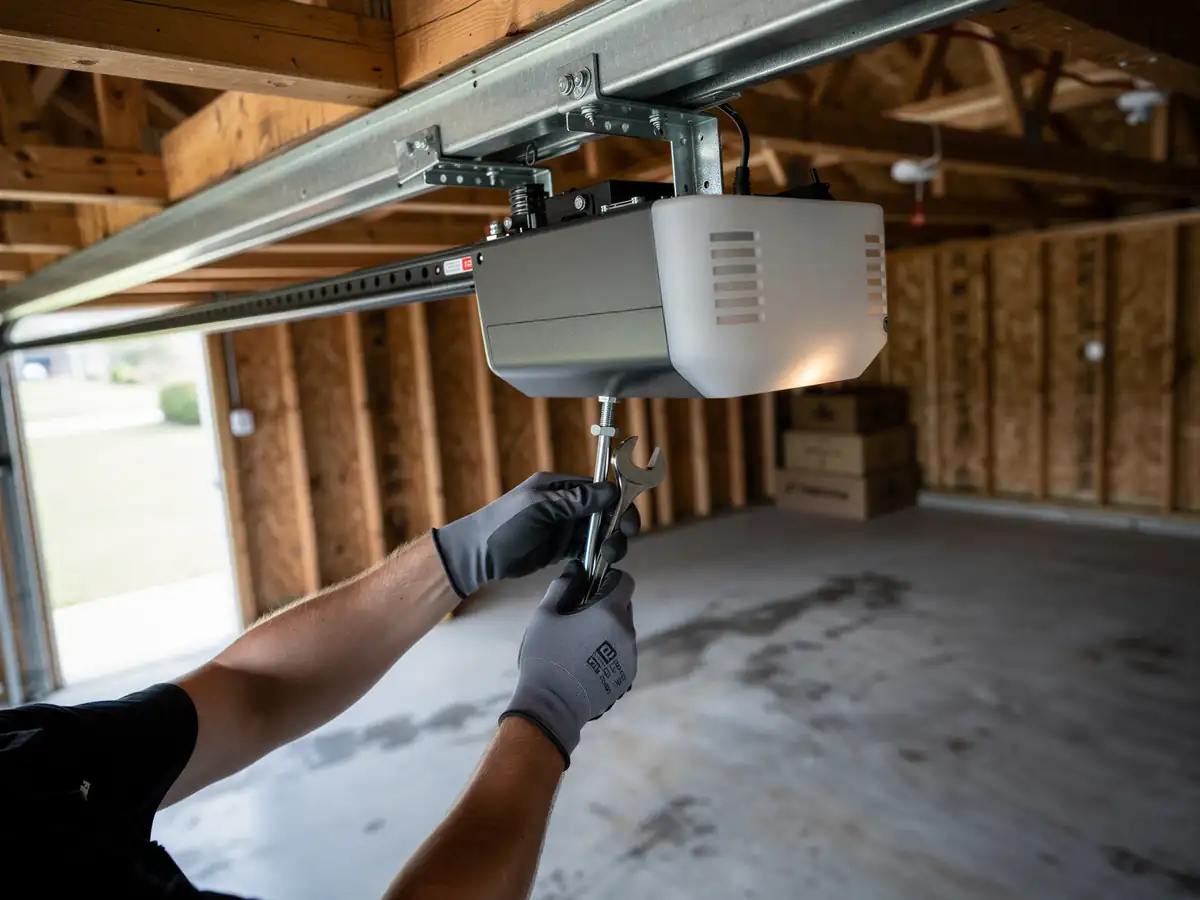
For opener installation calls in this service area, the truck carries both belt-drive and chain-drive units in common lift capacities, plus the brackets and rail hardware sized for the shorter headers typical of houses built before the 1970s. We also stock battery backup units, since outages during cold snaps are a real concern for a household that can't get a car out otherwise.
What we don't carry on every truck is specialty wiring for homes with unusual electrical panels or openers tied into smart-home systems that need a specific hub - that's a known gap, and if your house needs it, we'll tell you up front rather than make you wait on-site while we sort it out. We'd rather say that now than leave a job half-finished.
Standard mounting hardware, rail sections, and the wall console and safety sensors that come with any new opener installation are always on the truck, regardless of which of the sixteen communities in our service area the call comes from.
What You Are Seeing
A grinding or straining sound when the door opens is usually the motor working harder than it should
Often because the opener predates current lift-capacity standards for the door it's attached to. A door that reverses partway up, or an opener that runs but the door barely moves, points to a chain or belt that's lost tension - common in houses with openers original to a 1960s or 70s build.
If the opener light flickers or the unit hums without lifting the door at all, especially on a cold morning
That's often cold-stiffened grease in an aging gearbox rather than a dead motor. It can look like total failure and still be a fixable part.
A remote or wall console that stopped syncing
With no mechanical noise at all, usually means the opener's logic board has failed - at that point, given how old the surviving original units in this area tend to be, replacement is usually the better call than chasing parts for a board that's no longer made.